Fixed synthetic lessons on mirror motion, harmonics, electrical pickup and coherent averaging.
Precomputed lessons. These four figures are fixed, explicitly stated acquisitions rendered by build_demos.py from the same synthetic PSI generator used in Explore. They are independent of the Explore controls and contain no experimental arrays. Settings, units and offsets are written in each figure.
The lessons are original simulations inspired by detector-position, artifact-baseline and phase-correlated averaging experiments in Rödig and Siebert (1999). They are not reproductions of that paper's data. Tap or click a figure to enlarge it.
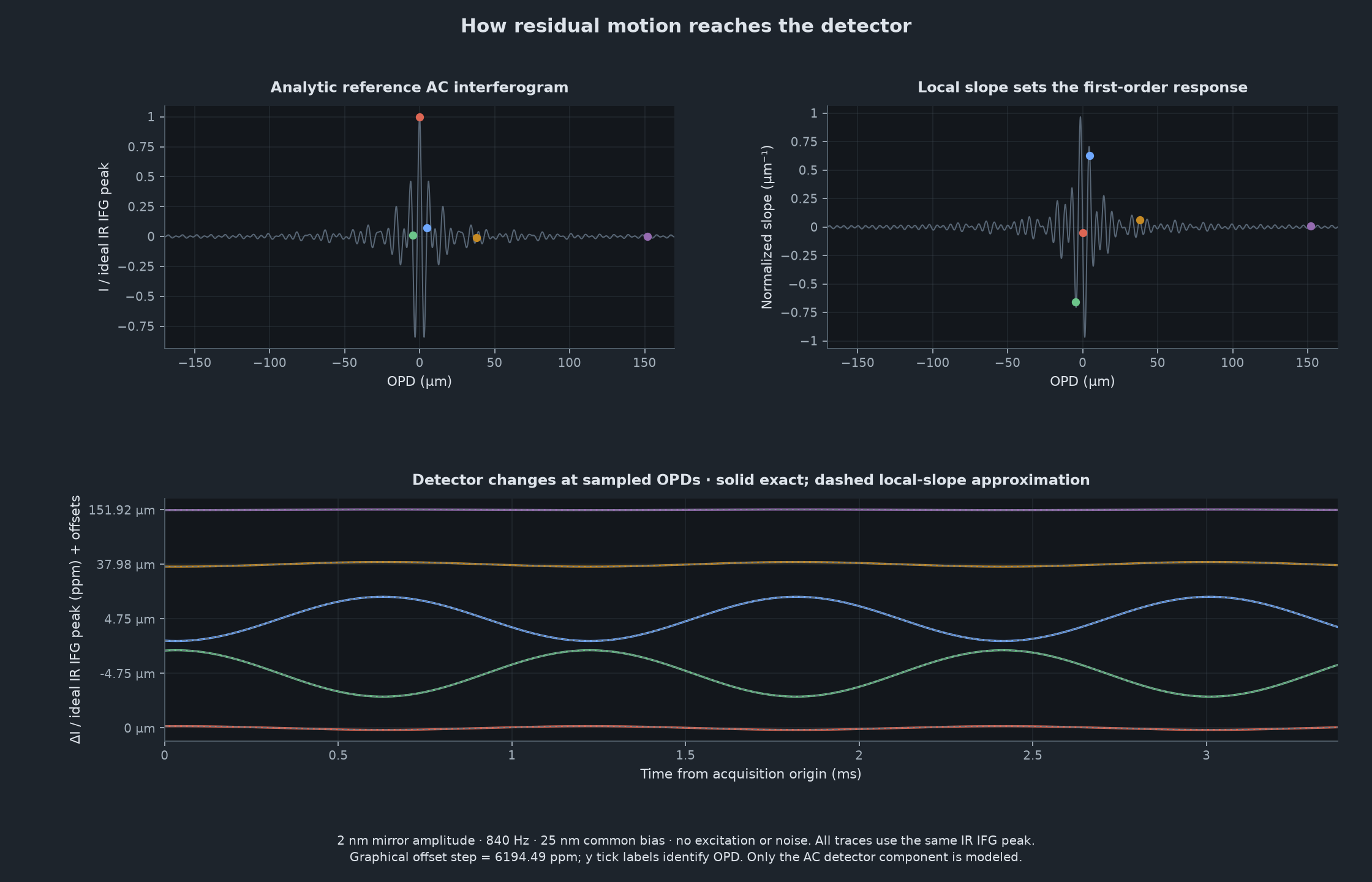
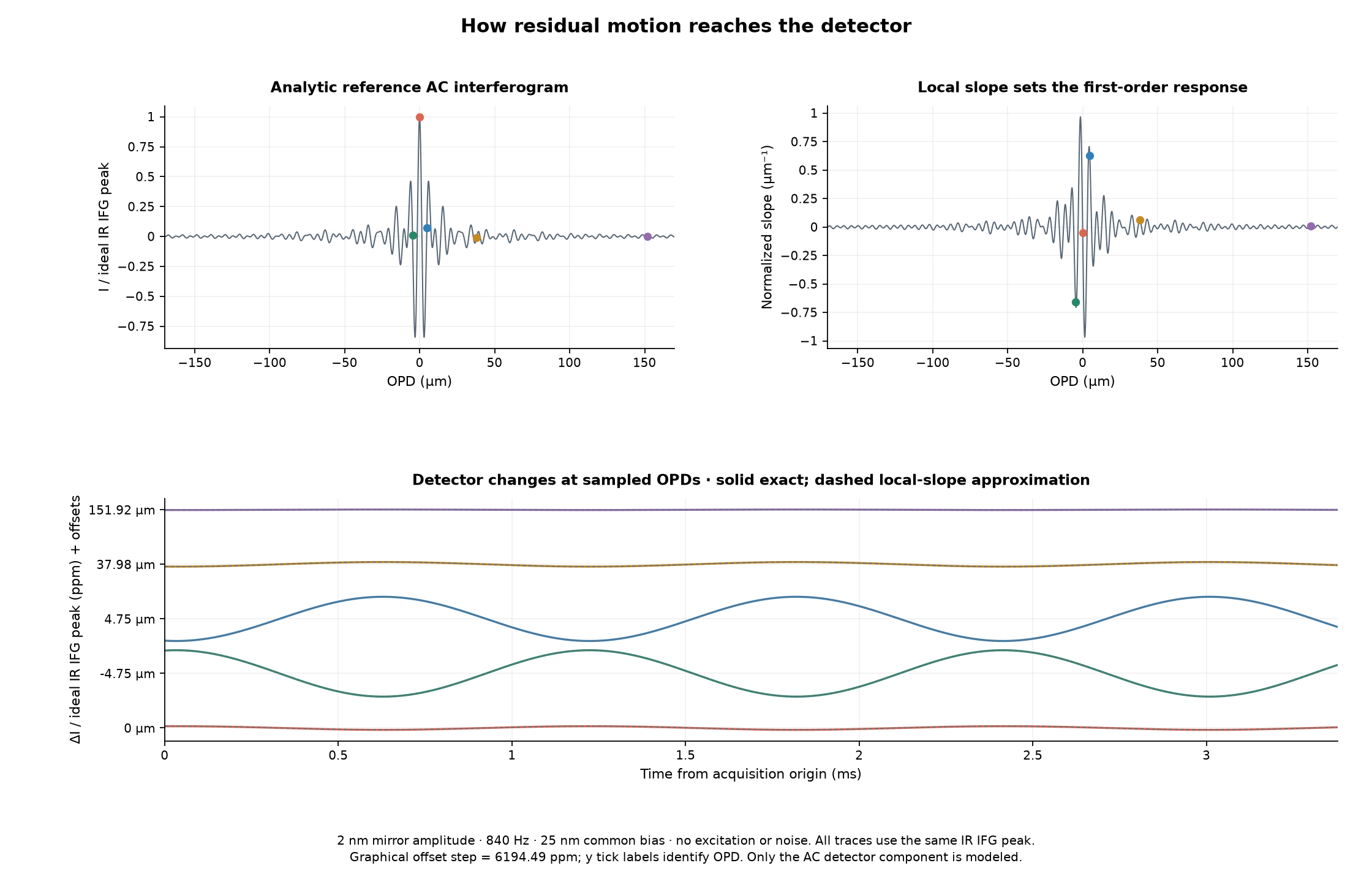
Figure 1. Original simulated OPD detector traces and their reference/slope. Solid traces use exact uniform displacement; dashed traces use the first-order local slope. There is no excitation or random noise. Parameters, units and offsets appear in the figure. Inspired by detector-position examples in Rödig and Siebert (1999), not a reproduction of their data.
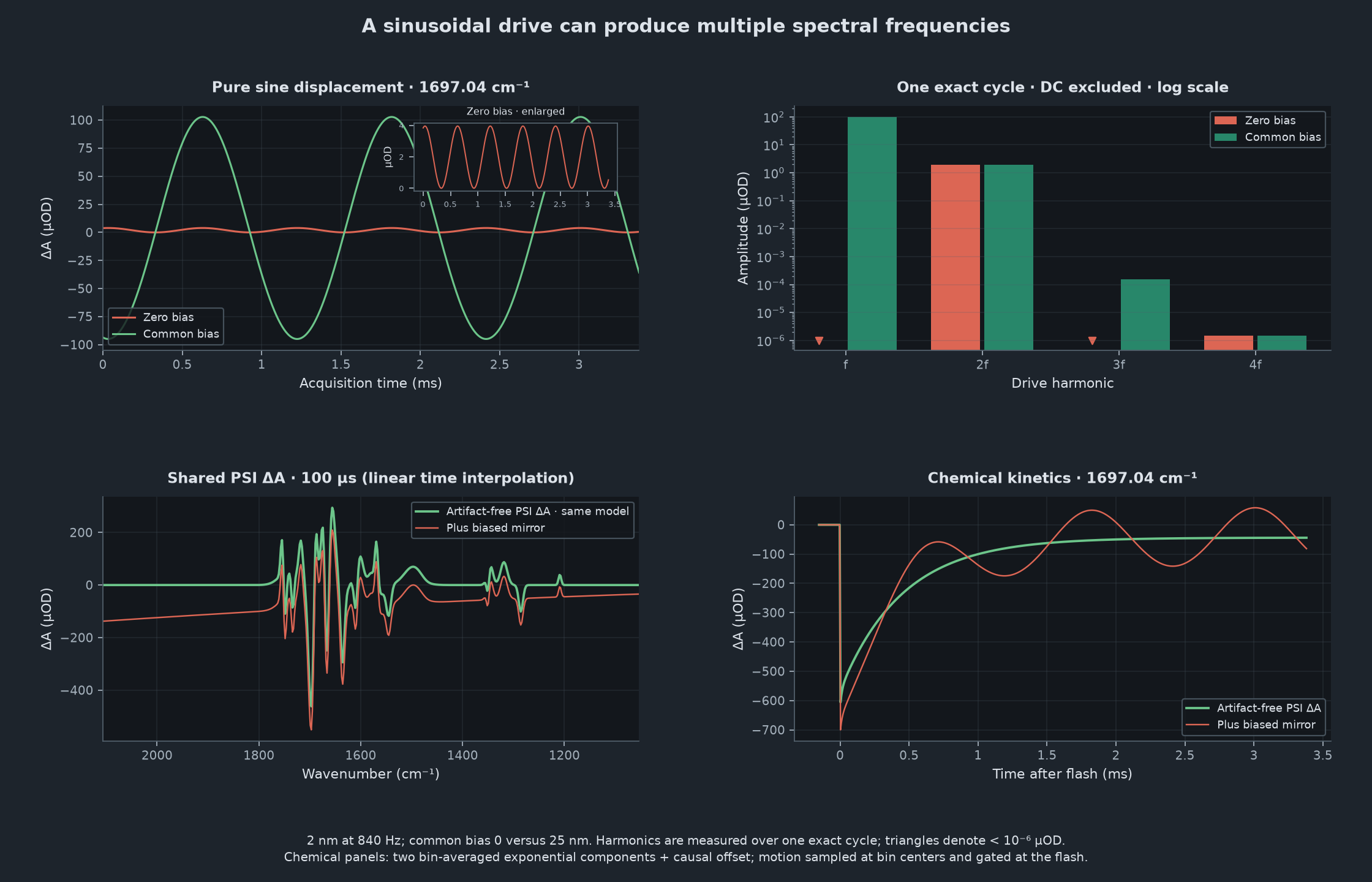
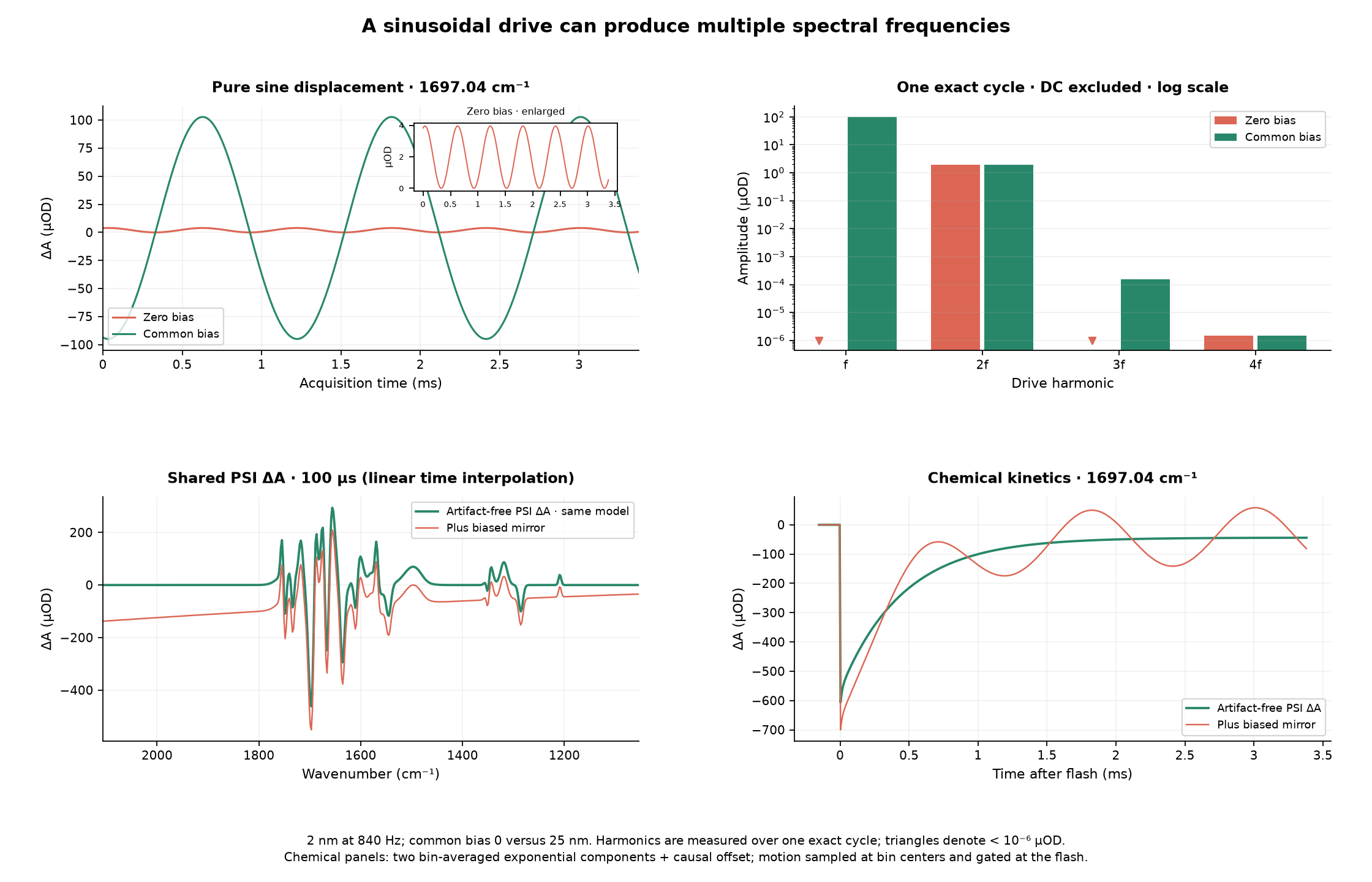
Figure 2. Pure sine motion with zero/common bias, harmonic amplitudes over one exact cycle, and superposition on the shared PSI input. DC is excluded from harmonic bars; amplitudes below the indicated floor remain in numerical exports. The chemical panels retain bin-averaged chemical bases and flash-gated, bin-center motion. Their timing differs explicitly from the ungated baseline lesson.
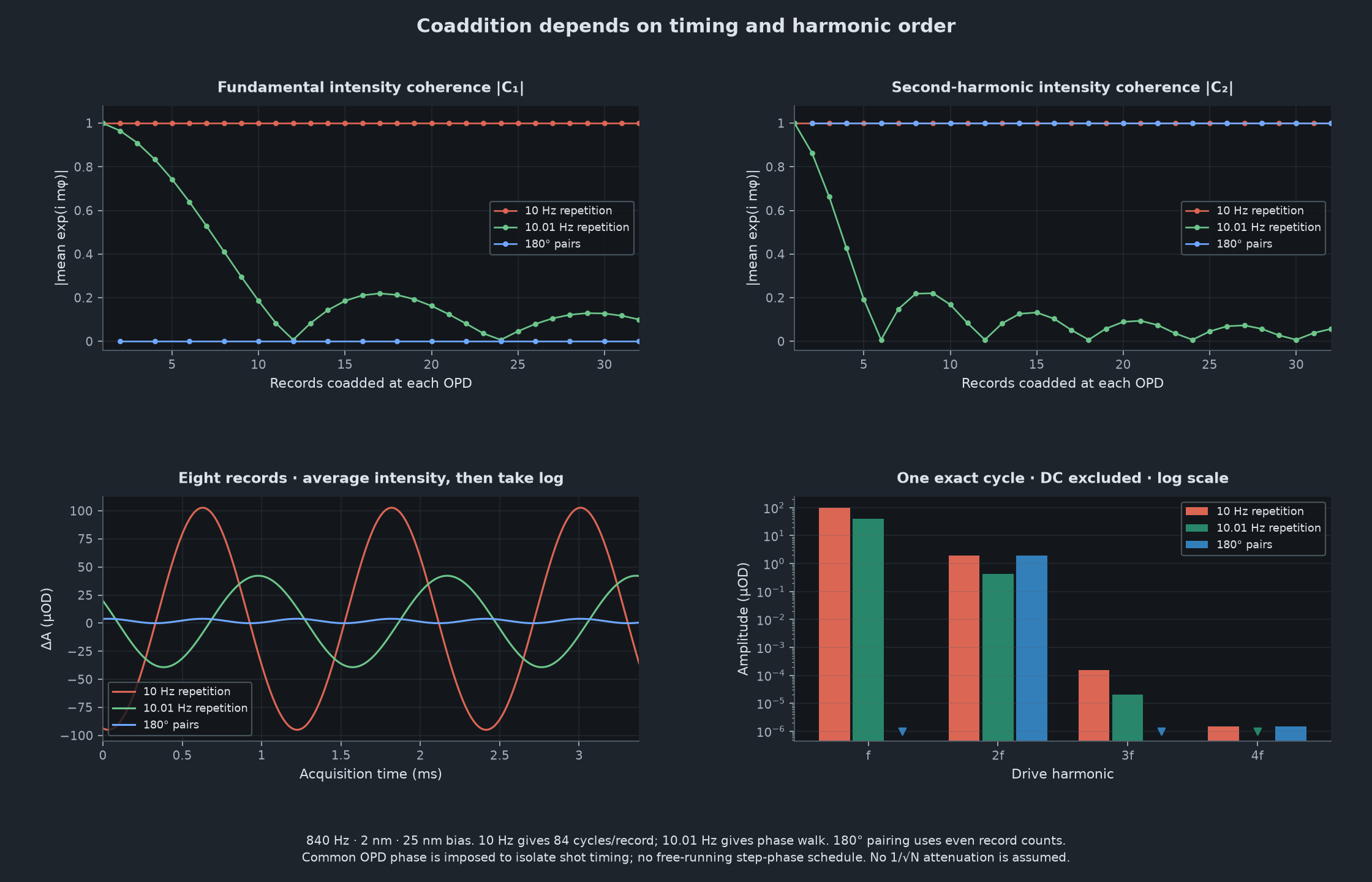
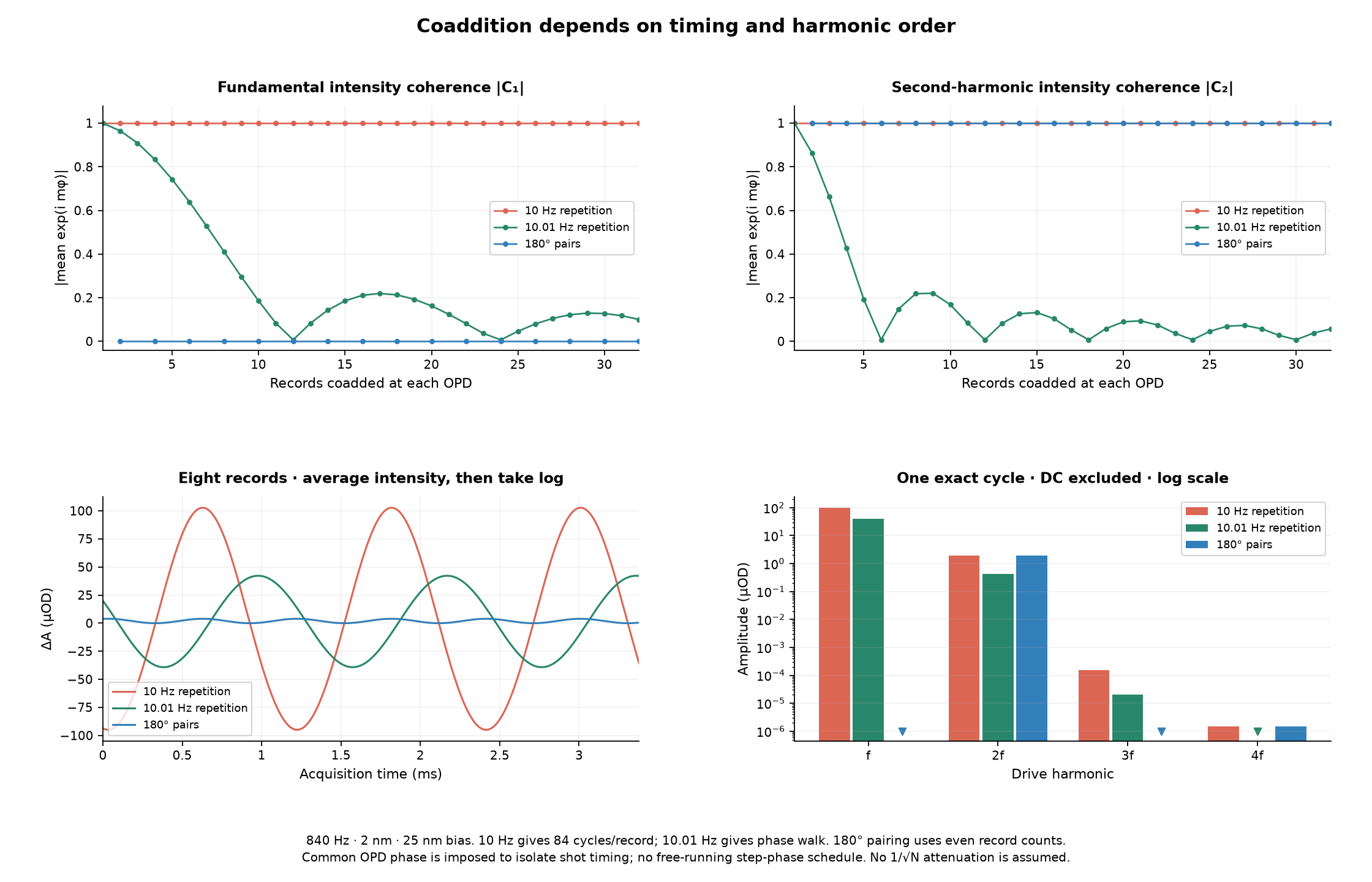
Figure 3. Original timing/coaddition lesson with eight-record traces and harmonic bars. The source paper discusses doubled-frequency survival under phase-correlated averaging on pp. 897–898. The plotted case is nonlinear mirror response: a purely linear additive electrical sine would cancel under ideal pairing and needs an even-harmonic/nonlinear contribution to show survival.
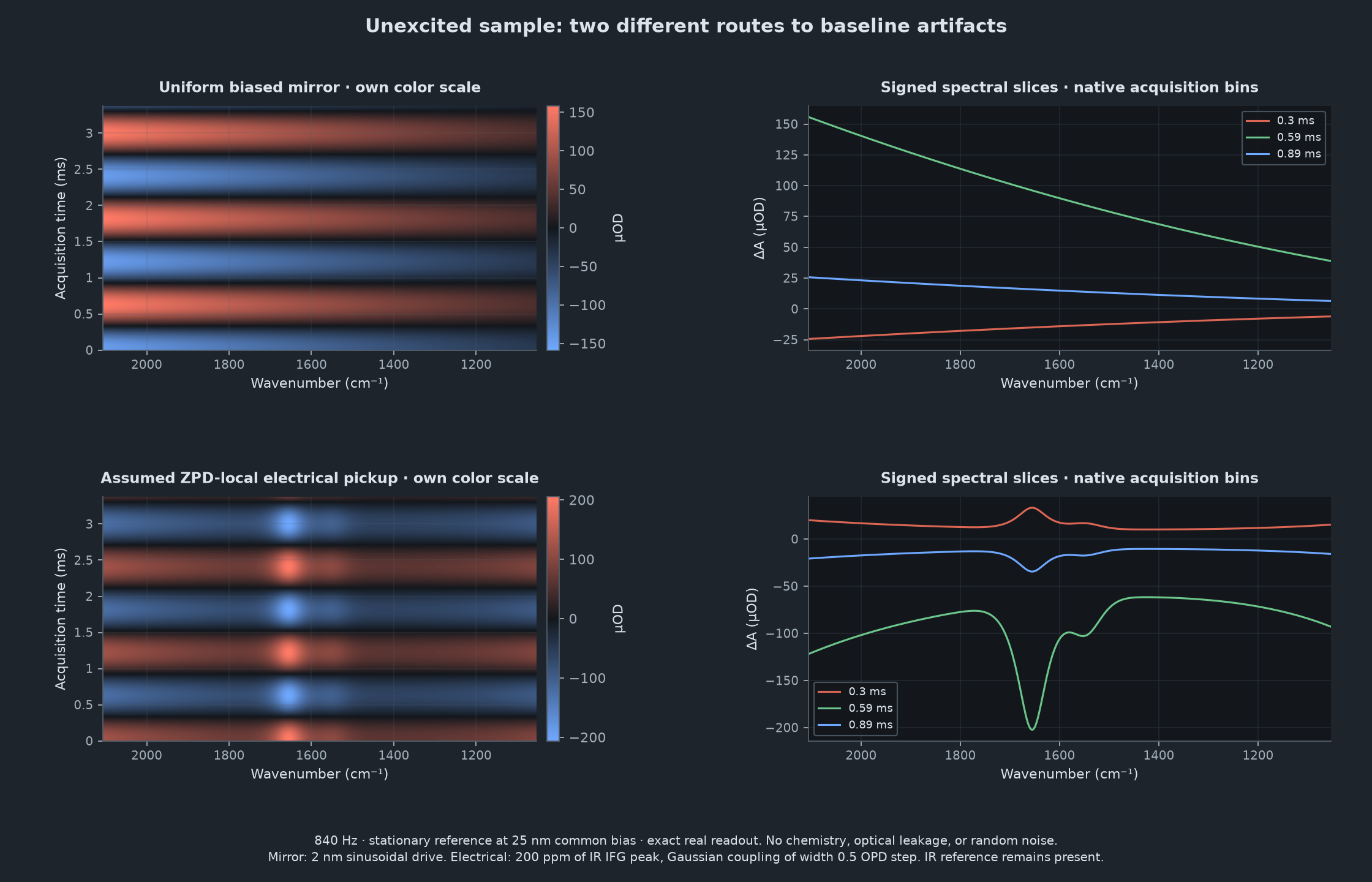
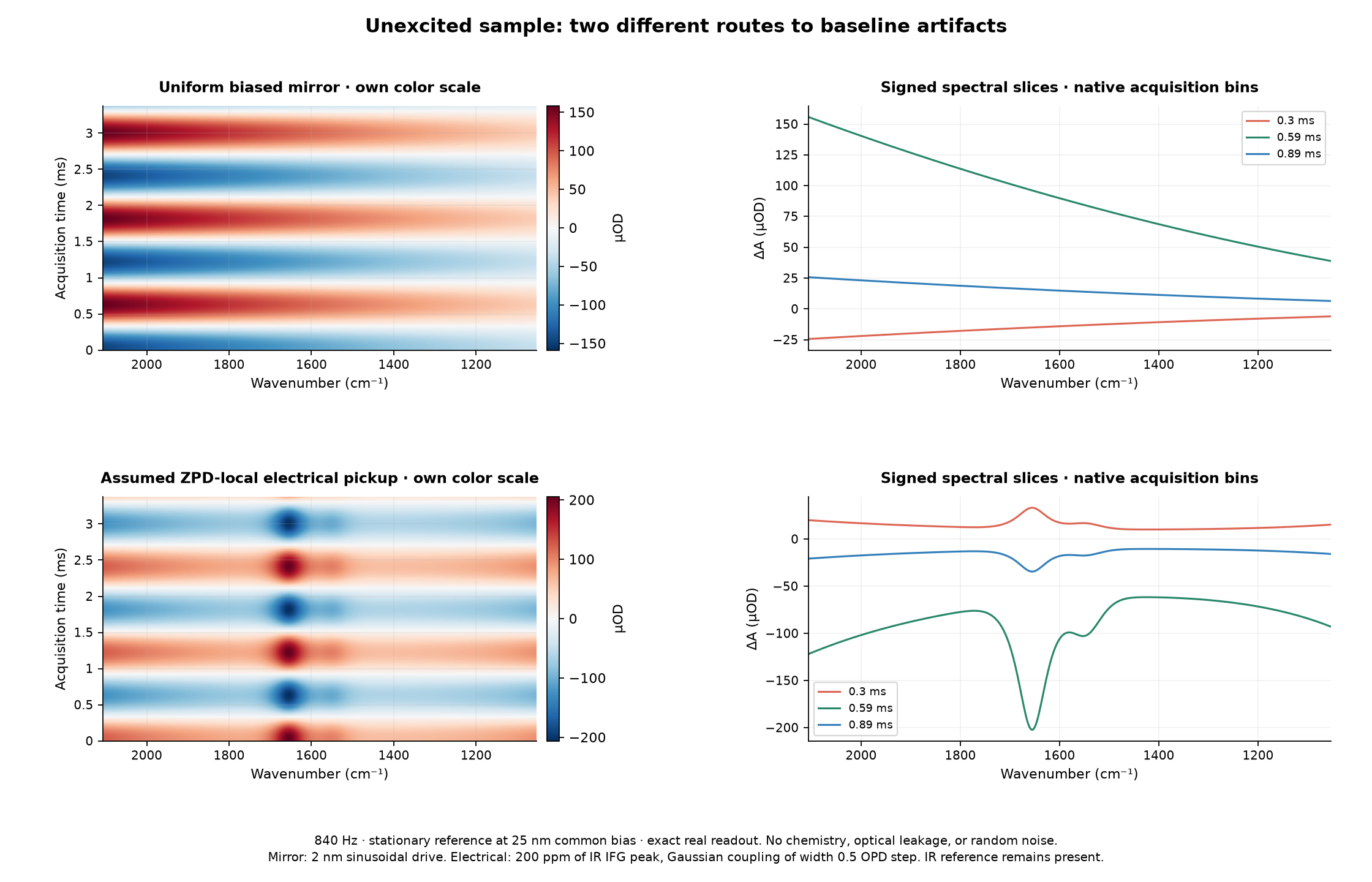
Figure 5. Original unexcited mirror/electrical maps and native-time slices. Each map has its own labeled signed scale. Acquisition zero is an arbitrary oscillator origin. The paper's imposed ±4 nm at 50 Hz differs from these illustrative 2 nm/840 Hz settings. Similar-looking oscillations do not establish identical mechanisms.
Run python -X utf8 build_demos.py in the repository to regenerate the light and dark figures and metrics.json. The desktop application shows the same lessons under Demonstrations and can export their numerical arrays.